Thursday, October 27, 2011

Recycling 411 in Madison County

On Friday, October 21, a small group students joined members of Colgate’s Sustainability Office on a field trip to the Madison County landfill and recycling center. Our goal was to become more familiar with where our waste goes and learn tips on how to better recycle. We learned that Madison County residents recycle approximately 6,000 tons worth of material each year. Additionally, the Madison County facility has implemented some really innovative projects pertaining to sustainable development and renewable energy. We wanted to share with you what we learned from our trip.


The Basics

Madison County has a two stream recycling center. Thus, as the name implies, we must separate our recyclables into two streams: 1) Paper and paper-based products must go in one container (to keep it dry and clean) and 2) aluminum, metal, glass, and plastic products must go in another container.


Paper and Cardboard

The golden rule of cardboard recycling: if it sits in your cupboard, it’s the perfect recyclable material! For example, cereal and granola bar boxes and even greasy pizza boxes can all be recycled. If you store it in the fridge or freezer, keep it out! This is because these cardboard products contain a plastic-like material that prevents them from falling apart when they become moist. Unfortunately, this material also contaminates paper recycling. For example, soda/beer boxes and cardboard milk containers must be thrown in the trash.

PHOTO: Paper products collected for recycling.


PHOTO: Paper products bailed and ready for recycling.


Aluminum, Metal, Glass and Plastic

The Madison County facility is able to recycle all 1-7 plastic products. But, before you throw your plastic in the recycle bin, make sure is “squeezable.” Another golden rule: if you squeeze it and it cracks, it’s trash; if you squeeze it and it’s pliable, it’s recyclable!

A few other tips: make sure to keep all Styrofoam products out of your recycling bin, clean your containers before discarding them and spend the extra second to drain your bottles and take the tops off (otherwise, someone else has to do it for you- think about unscrewing the caps off of hundreds of bottles a day).


PHOTO: Glass/metal/plastic products collected for recycling.

PHOTO: Glass/metal/plastic products bailed and ready for recycling.


Other Recycling Products

Yes, you can recycle your plastic bags from the grocery store. That is, if you aren’t already using a reusable one or reusing them yourself. Fill up one bag with others and put them in with your paper recycling bin. Also, you can recycle old clothing (shirts and shorts – yes; socks and underwear – no!). These products donated or used to make rags and other products. Once again, keep these in a dry bag and place them in your paper recycling bin. Lastly, if you have any old pots and pans, feel free to put them to good use! Throw them in a separate bag or put them in with the paper.


Recycling Solid Waste for Energy

The Madison County facility is at the forefront of utilizing renewable energy technologies. The facility has topped the landfill with thin and flexible solar panels.

PHOTO: Flexible solar PV array on capped landfill cell.


This solar PV array is estimated to generate 40,000 kWh’s of power per year; that’s enough to provide electricity to approximately 30,000 homes. In addition to this new project, the landfill is capturing the methane that is produced from the breakdown of solid waste. The methane is piped and combusted to provide 1,000 kilowatts of electricity per hour; that is enough to heat 200 homes per year. Moreover, the by-product is heat that is used to heat all of the facilities buildings!

If any of your basic recycling questions have not been answered, be on the look out for the first-ever Colgate Recyclepedia! Also, be sure to keep others informed! Education and awareness are the first steps towards a more sustainable future.

Monday, October 3, 2011

Colgate targets 2019 bicentennial for carbon neutrality

Colgate has set an ambitious target date to become carbon neutral by 2019, the university's 200th anniversary. In so doing, President Jeffrey Herbst again confirmed the high priority of sustainability practices on campus.

That aggressive target date will be attained through the implementation of 27 proposed on-campus mitigation projects, each outlined in Colgate's Sustainability and Climate Action Plan, submitted to the American College and University Presidents' Climate Commitment (ACUPCC).

For purposes of the ACUPCC, climate neutrality is defined as having no net greenhouse gas (GHG) emissions, to be achieved by minimizing GHG emissions as much as possible, and using carbon offsets or other measures to mitigate the remaining emissions.

"Our aggressive time frame makes sense in terms of good global citizenship as well as Colgate's academic mission," said Herbst, "and it is also fiscally responsible."

Click here to learn more.

Colgate enters innovative carbon offsets agreement

As part of its aggressive push to reduce greenhouse gas emissions and advance sustainability, Colgate has signed a 15-year commitment with Patagonia Sur to purchase forestry-based carbon offsets. Under the agreement, a total of 225,000 native-species trees will be planted on 430 acres of land in Chile's Aysén Region of Patagonia.

The Colgate University Forest, as the land will be known, will meet or exceed global verified carbon standard requirements. Annually, the forest will offset approximately 5,000 tons, or about one-third of Colgate's present carbon footprint.

Click here to learn more.

Colgate University Receives National Climate Leadership Award

On June 23, 2011, Colgate received Second Nature’s Climate Leadership Award in the Baccalaureate category from the American College & University Presidents' Climate Commitment (ACUPCC). At the organization's Climate Leadership Summit in Washington, D.C., John Pumilio, Colgate's sustainability coordinator, and Lyle Roelofs, provost and dean of the faculty, accepted the award on the university's behalf.

In 2010, Colgate University reduced its greenhouse gas emissions by 17 percent (from 17,323 MTeCO2 in 2009 to 14,451 MTeCO2 in 2010). This reduction is mainly the result of conservation and efficiency projects through:
  • a 24 percent decrease in fuel oil consumption (nearly 88,000 gallons less in 2010 compared to 2009)
  • a 4 percent decrease in electricity consumption (1.3 million kWh less in 2010 compared to 2009)
  • a 33 percent decrease in paper use (43,000 lbs less in 2010 compared to 2009)
  • a 4 percent decrease in landfill waste (34 tons less in 2010 compared to 2009)

Combined, conservation and efficiency saved the university nearly $300,000 in operating costs while enhancing its liberal arts education as student participation was integral to these results through academic research, governance, and co-curricular club activities. Additionally, student-driven behavior change programs such as Eco-Olympics and the Green Living Program were designed by students and implemented for the first time in 2010.

In 2010, Colgate used 23,000 tons of locally-grown wood chips to provide heat and hot water to campus. Their wood-fired boiler displaced over one million gallons of fuel oil, avoided over 13,000 metric tons of emissions, and saved the university over $2 million in energy costs. CU is also experimenting with cropped biomass in the form of an 8-acre willow plot in the hopes of cultivating some of its own energy.

In 2010, the institution also implemented a full-blown electronic waste recycling program with 18 stations located throughout campus, implemented a new composting program, and broke ground on a new half-acre community vegetable garden. Vegetables and herbs from the garden were sold back to the university and served in its dining halls. Each program was funded by the Class Gift of 2010 and, students are currently overseeing each of these initiatives. Colgate’s administration leads by creating opportunities and opening pathways for student research and innovation.

Regarding transportation, Colgate expanded its Green Bikes program by purchasing an additional 12 bikes and introduced a new online carpooling program in order to help reduce its employee commuting emissions.

Colgate’s Green Office Program, also introduced in 2010, is indicative of their approach. Eight teams representing 65 employees registered for and are actively pursuing official Green Office Certification.

In April of 2010, Colgate’s faculty officially approved the goals of a Colgate education. Among them, they specified that a Colgate education should enable students to “recognize their individual and collective responsibilities for the stewardship of the earth’s resources and the natural environment” and graduate as “engaged citizens strive for a just society.” To meet these ends, Colgate offers numerous courses focused on sustainability and climate change.

Friday, June 17, 2011

Colgate Community Vegetable Garden hosts its first Work Party of the 2011 season!

Members of the Colgate campus community showed up yesterday afternoon for the first Colgate Vegetable Garden Work Party of the 2011 season!

The Colgate vegetable garden is in its second season, having been established in June of last year. The garden is managed during the summer by two student interns - Ray Peña ('12) and Jess Halter ('13). Cazenovia resident and life-long gardener Stacey Nagle works as a part-time consultant for the garden, lending her expertise to Ray and Jess.

Ray, Jess, and Stacey have had their hands full so far this season, battling weeds and recreating raised beds that had been swept away by heavy Spring flooding earlier this year. Their hard work is paying off, and many crops have been planted, including squash, cucumbers, carrots, heirloom tomatoes, hot peppers, and radishes to name a few. The garden crew has plans for an herb garden in the near future as well.

Yesterday's work party was attended by a number of volunteers from the campus community. The volunteers helped spread black mulch on the raised plant beds, and in so doing helped the recently planted crops retain water. Volunteers also helped spread wood chips on paths between the raised beds, which will allow visitors the chance to explore the garden without being mired in mud. After their hard work, volunteers were treated to Iced Tea and shade by the garden shed.


Colgate's Community Vegetable Garden is an excellent example of the kinds of sustainability initiatives occuring all over the campus. The garden was conceived of by students and financed by Colgate's Sustainability Fund and the Sustainability Council. In its second year, the garden hopes to involve the campus community - students, staff, faculty, and Hamilton residents - in the gardening process, and promote sustainable agriculture. Come harvest time, the crops will be made available to students at the garden shed, located next to the garden in the area behind the Newell Apartments.

Students wishing to get involved with the garden can join the Green Thumbs campus group (GreenThumbs@colgate.edu) or contact the Sustainability Office (Sustainability@colgate.edu). Jess, Ray, and Stacey hope to host more work parties over the summer and fall, and welcome the assistance of anyone interested. Follow Colgate Sustainability on twitter (@colgatesstnblty), or on Facebook () for information about future Garden work parties and all things green at Colgate!

Monday, June 14, 2010

Where Does Colgate's Electronic Waste Go?

On Friday, June 11th, Colgate’s sustainability interns Meghan Kiernan ‘11 and Andrew Pettit ’11 took a road trip with Sustainability Coordinator, John Pumilio, to visit RCR&R, the Regional Computer Recycling & Recovery center. For the past 6 years, RCR&R has been handling Colgate’s electronic waste (eWaste) in order to guarantee the safe and appropriate disposal of these hazardous materials, including computers, monitors, circuit boards, batteries, cabling, and televisions.


The relatively new company was founded in 1995 by the current President and Owner, Mike Whyte. RCR&R’s mission is to provide cost effective and safe environmental solutions for the disposal of outdated or broken technology products. Using their own version of the 3R’s, RCR&R focuses on 3 methods of disposal: Reuse, Recovery, and Recycling. 


Our goal for this field trip was to acquire information for students and staff regarding eWaste and answer questions that could be brought up in the future.

Why should we recycle eWaste?

Electronic equipment contains metals and toxic materials that can be harmful to human health and the environment if they are not properly managed. If these technologies are disposed of in landfills then destructive metals such as Cadmium, Lead, and Mercury can be leached into the soil or burned and be released into the atmosphere.


What happens to our electronics after they are delivered to RCR&R?

Colgate's eWaste is picked up and dropped off at the RCR&R facility where it is processed, broken down, and sorted. RCR&R, then, either resells the equipment or recycles the unusable components by sending parts downstream to other companies that specialize in managing a specific component.

As a whole, eWaste has very little resell value due to the current technology boom. Many computers in the modern age become obsolete within two years, which makes reselling them at a cost effective price very difficult.


How does RCR&R ensure that the electronic parts they sell to the further de-manufacturers do not just end up in a landfill?

RCR&R personally audits the primary and secondary companies that it sends its recyclable components to, to make sure that the downstream businesses dispose of the electronic waste correctly. 


How does RCR&R dispose of plastic waste?

Although there is a limited market for mixed plastics, RCR&R compacts all of the plastic it receives from monitor, computer, and television housings and sells it to outside vendors who reuse the plastic in their products. 


If I decide to recycle my old computer, how does RCR&R provide me with data security?

All the circuit boards that RCR&R receives from computers or other electronic devices are personally put through a metal shredder that completely renders the circuit board useless. RCR&R also has the ability to wipe the memory of any circuit board they receive that erases all the data on the drive. These boards are still very likely to be placed in the shredder afterward. 


How many pounds of eWaste does Colgate produce per year?

Between June 2008 and June 2010 Colgate produced 38,566 lbs. of electronic waste not including eWaste collected by the student body.

Also, the interval between May of 2008 to February of 2009 shows that Colgate forwards roughly 1,900 lbs of eWaste to RCR&R each month. This 1,900 lbs only includes devices purchased by the University.


How can we help recycle eWaste?

Colgate has created an electronic waste center at the COOP to help students sort and identify items that are considered “electronic waste.” This new centralized E-WASTE station at the COOP, between the dining center and the C-Store, simplifies the process of sorting, in hopes of increasing student compliance. Students and staff can recycle batteries (wrapped in tape), iPods, cameras, cellphones, CDs/DVDs, cables, ink cartridges, lightbulbs (wrapped in newspaper), and larger electronic equipment such as laptops or printers.

For more information visit the RCR&R website at www.eWASTE.com and for further questions about eWaste at Colgate email Colgate's Sustainability Coordinator, John Pumilio, at jpumilio@colgate.edu.

Monday, June 7, 2010

COLGATE STAFF AND ALUMNI LEND A HELPING HAND IN COMPOSTING

by Meghan Kiernan '11


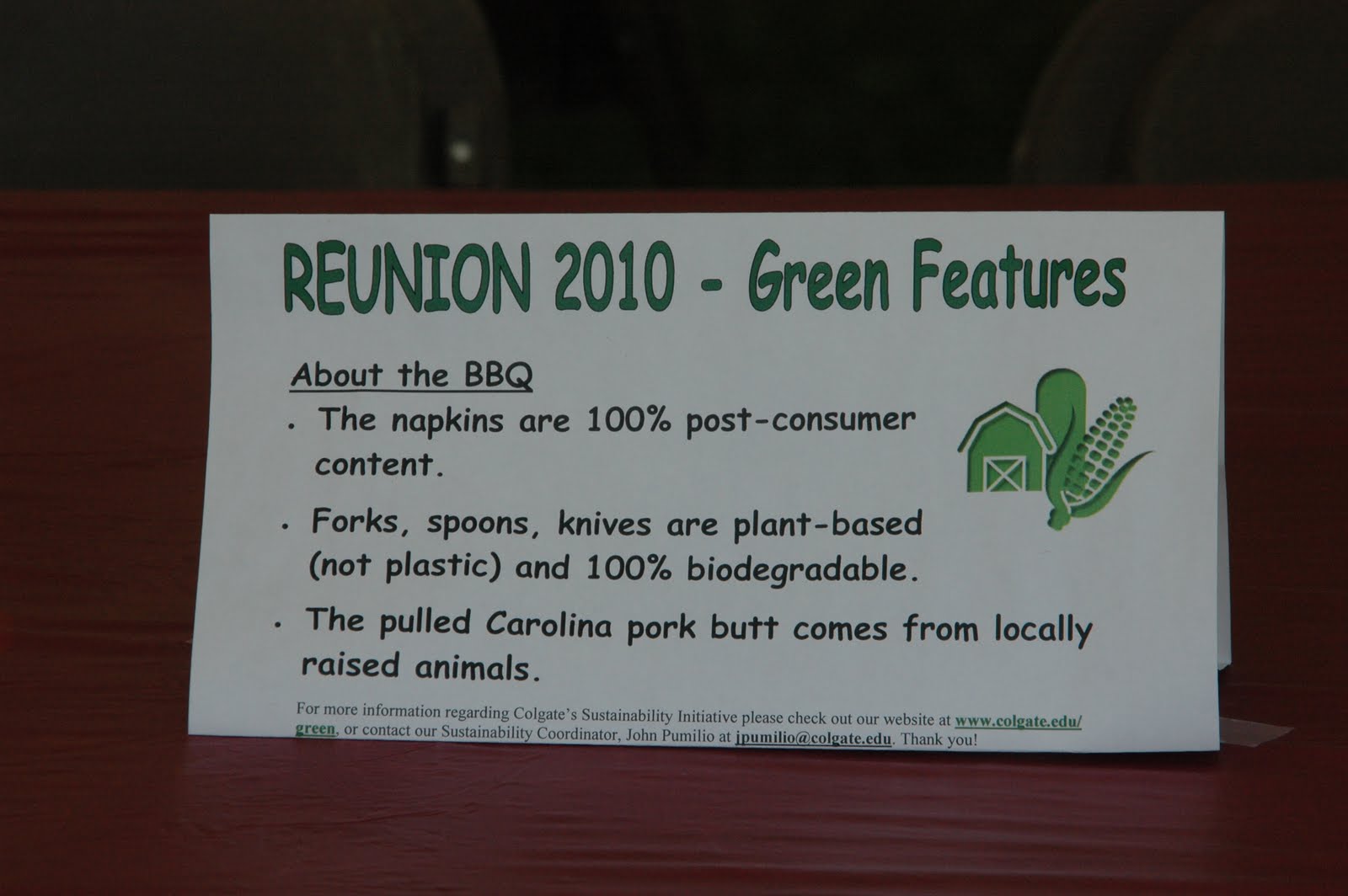
Colgate would like to thank participating alumni and organizers for the overwhelming success of Friday’s “Green Day” BBQ lunch during Reunion 2010. During this lunch, approximately 80 lbs of food scraps were diverted from the landfill to be composted on campus! This was the first major event at Colgate where composting food scraps was possible. Colgate staff and alumni were enthusiastically supportive of this effort and everyone did their part by scraping their fruit and vegetable scraps into the designated composting bins.


The food scraps will compost over the summer. The finished compost will be used at Colgate’s new organic vegetable garden to help grow vegetables for next year. The success of Friday's BBQ illustrates that Colgate is capable of composting which has promising implications for the future: helping to close the food loop while driving down landfill tipping costs when operated on a larger scale. Additionally, diverting food scraps from the landfill also prevented over 96 lbs of greenhouse gas emissions from entering our atmosphere.

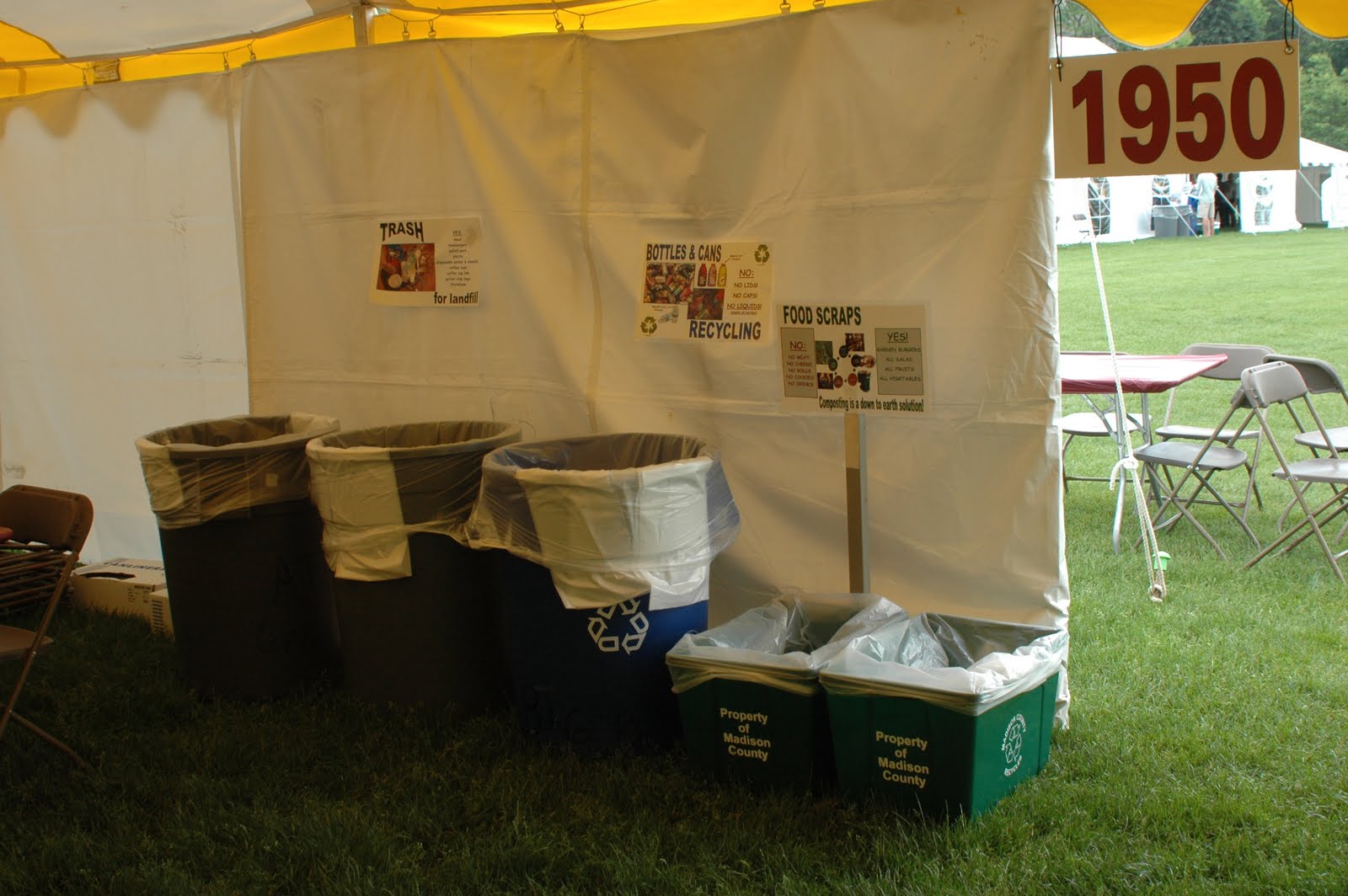
Colgate’s recycling initiative was also on display as each trash can was accompanied by recycling and composting bins. Signs helped to instruct alumni for easier, more efficient sorting.


We would love to hear your feedback. Please let us know if you have any ideas that we can implement in future years to advance our continued commitment to sustainability at Colgate.

Again, thank you to everyone who helped to make this year's BBQ lunch so successful!